
Articles
The science of composting: how biodegradable packaging really breaks down
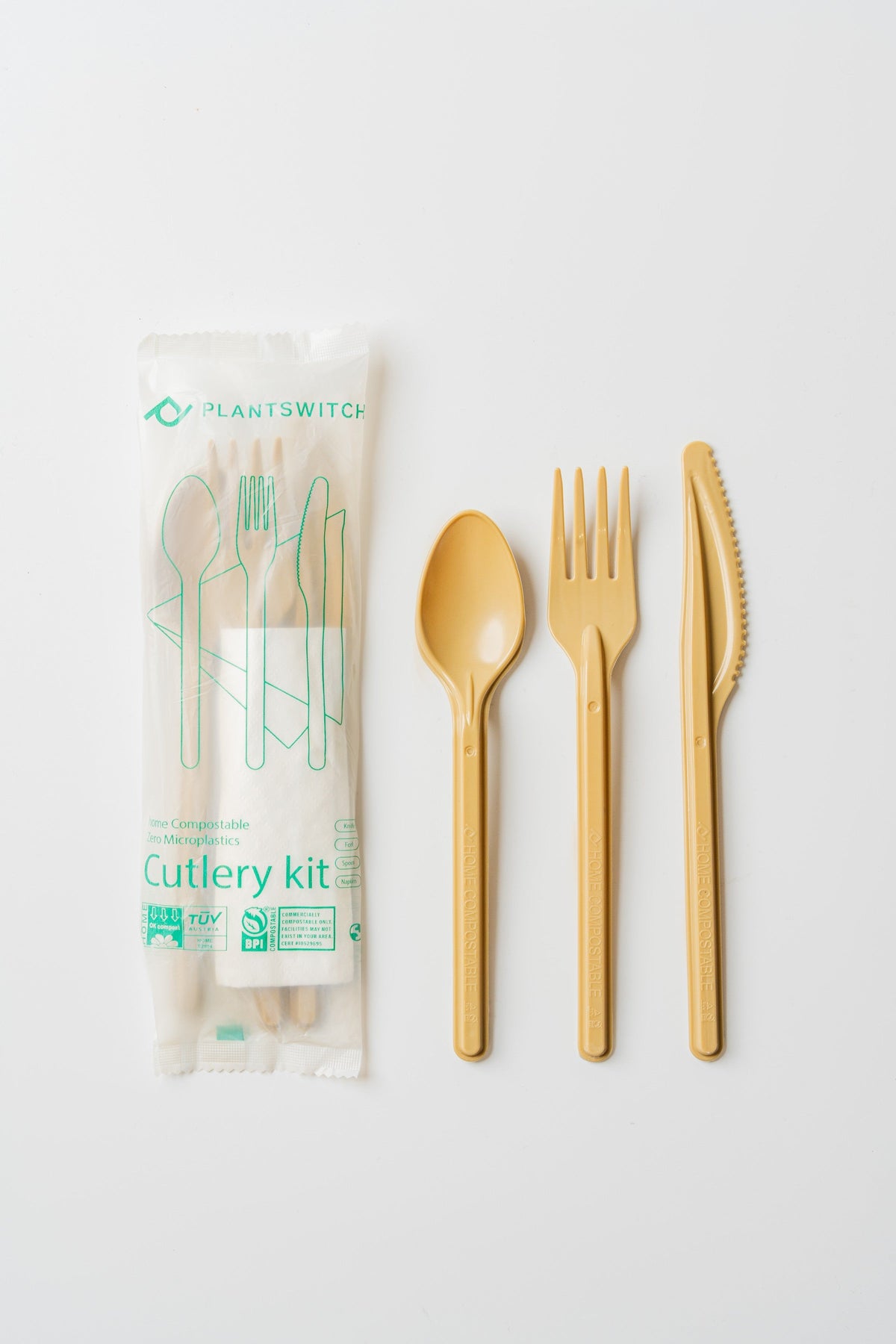
Plenty of forks, cups and lids carry a green leaf and the word "compostable." Very few explain what that word promises: composted where, at what temperature, over how long, and what happens if the item ends up somewhere else. For a buyer who has to stand behind a sustainability claim, that gap is a real risk. The science behind it is not complicated, but it is precise, and it comes down to two questions: can microbes in a given place digest the material, and do the conditions there let them?
This guide walks through how biodegradation works, what the labels legally mean, why PHA and PLA behave so differently, and what each certification actually tests.
What biodegradation means at the microbial level
Falling apart is not biodegrading. A bag that cracks into tiny pieces under sunlight has only become smaller plastic. True biodegradation is microbes eating the material and turning it into carbon dioxide, water and new cell mass. A review in Frontiers in Microbiology describes four stages:
- Biodeterioration: microbes settle on the surface and start to change it.
- Biofragmentation: enzymes the microbes release cut the long polymer chains into short pieces.
- Bioassimilation: those pieces are small enough to pass into the microbial cells, which use them as food.
- Mineralization: inside the cell the carbon ends up as carbon dioxide and water (plus methane where there is no oxygen).
Two things decide whether that chain runs to the end. The first is chemistry: microbes need enzymes that can attack the bonds holding the polymer together. Polyesters such as PHA and PLA have ester bonds that enzymes can cut, while conventional plastics are built from carbon chains that microbes struggle to break. The second is structure. The same review notes that enzymes work mainly on the loose, disordered (amorphous) regions of a polymer, so highly crystalline materials break down more slowly.
Degradable, biodegradable, compostable: what each label promises
These words get used as if they mean the same thing. They do not.
| Label | What it means | What it does not tell you |
|---|---|---|
| Degradable | The item breaks into smaller pieces over time, by any means. | Whether microbes ever digest those pieces. Oxo-degradable plastics fragment this way, which is why the EU restricts products made from oxo-degradable plastic. |
| Biodegradable | Microbes can break the material down. | Where, or how fast. The FTC's Green Guides call an unqualified degradable claim deceptive for items that won't completely decompose within one year of customary disposal, and say landfills, incinerators and recycling facilities don't offer those conditions. |
| Compostable (industrial) | The item passed a standard test in a hot, managed composting facility. | Whether it breaks down in a home bin, soil or water. |
| Home compostable | The item passed a test at ordinary backyard temperatures. | Whether a local program accepts it; that depends on the collector. |
The step most brands miss is the gap between industrial and home composting. An industrial certification only proves breakdown at high heat, and many people have no access to a facility that runs that hot. Home compostable certification is the harder test because the material has to break down without that heat.
How PHA and PLA break down, and why they differ
PHA: a material microbes already know
PHA (polyhydroxyalkanoates) is made by bacteria. They build it inside their cells as an energy store, the way animals store fat. Because it comes from biology, the enzymes to take it apart are common in nature. A 2025 review in Frontiers in Microbiology reports that bacteria and fungi release PHA depolymerases, enzymes that attach to the PHA surface and cut its ester bonds into small pieces the microbes then use as food. With oxygen the end products are carbon dioxide and water; without it, carbon dioxide and methane.
The same review lists PHA-degrading microbes in soils, hot springs, freshwater and marine ecosystems, and calls PHA degradation "widely distributed among bacteria." That spread is why PHA as a material biodegrades in soil, freshwater and marine environments, not only in compost. Speed still varies: a 2025 review in the journal Biodegradation notes PHA breaks down more slowly in water than in soil.
PLA: a material that needs heat first
PLA (polylactic acid) starts as lactic acid fermented from plant sugars, which is then joined into long chains by an industrial chemical process. Microbes can't attack the finished polymer directly. Water has to break the chains down first, and that step only runs well near or above PLA's glass transition temperature, roughly 55 to 60 °C. That is industrial composting heat.
A 2022 paper in Polymers cites a study that composted PLA for 119 days at three temperatures: it reached 92.3% mineralization at 58 °C, but only 19.5% at 37 °C and 14.9% at 25 °C, which is about backyard temperature. In seawater the picture is starker. Researchers at the Scripps Institution of Oceanography found that PLA did not degrade in the marine environment for over 428 days, published in PLOS ONE in 2023. For more on why, see why PLA isn’t actually compostable.
Four places packaging ends up
Packaging does not always reach the bin it was designed for. Here is how the two materials behave in each setting. The table describes the materials in general; what a finished product can claim depends on its own certifications.
| Where it ends up | Typical conditions | PHA as a material | PLA |
|---|---|---|---|
| Industrial compost | Hot (about 55 to 60 °C), managed moisture and air | Breaks down | Breaks down when the heat lasts long enough |
| Home compost | Ambient, about 20 to 30 °C | Breaks down; products can be certified home compostable | Very slow: 14.9% mineralization at 25 °C over 119 days in one study |
| Soil | Ambient, variable | Biodegrades; PHA-degrading microbes are common in soil | Slow without heat |
| Freshwater and sea | Cool, wet, variable | Biodegrades, more slowly than in soil | No degradation over 428 days in the Scripps study |
The microplastics question
Microplastics form when an item breaks into pieces that microbes can't finish off. So the real question for any material is whether its fragments stay on the menu.
For PLA outside a hot facility, the answer is often no: the same heat-dependent first step that slows the whole item also slows its fragments. For PHA, the fragments are made of the same polymer that the enzymes already attack. The Biodegradation review concludes that "upon biodegradation no PHA microparticles (MP) are left in the environment." The pieces keep getting eaten until they are gone. That is the basis for the CompostZero™ message: No Forever Microplastics.
We cover this comparison in more depth in our PHA vs PLA guide.
What the certifications actually test
A certification is only as strong as the test behind it. These are the ones you will see most often on foodservice products.
| Standard | Who certifies against it | Test conditions | What passing proves |
|---|---|---|---|
| ASTM D6400 | BPI (North America) | Industrial composting where thermophilic (hot) conditions are reached | The item composts in a municipal or industrial facility |
| ASTM D6868 | BPI (North America) | Same industrial conditions, for paper or other items with a plastic coating | The whole item, coating included, composts industrially |
| EN 13432 | TÜV Austria, DIN CERTCO (Europe) | At least 90% biodegradation within six months; under 10% residue after 12 weeks of composting; no harm to plant growth; heavy metal limits | The item composts in an industrial facility |
| OK compost HOME | TÜV Austria | At least 90% biodegradation within 12 months at 20 to 30 °C; disintegration within six months | The item composts at backyard temperatures |
Two points matter for buyers. First, industrial certifications say nothing about home compost, soil or water. Second, check that the certificate covers the finished item you are buying, not just the resin it is made from.
A checklist for judging any compostability claim
- What is the material: PHA, PLA, a blend, or coated paper?
- Is the item certified home compostable, or only industrially compostable?
- Does the certificate name the finished product, and is it current?
- If the item has a coating or liner, does the whole item hold certification?
- Does the supplier make any claim about breaking down "anywhere" or in a set number of days? Ask for the certificate that backs it.
- Selling in California? From June 30, 2027, CalRecycle requires products labeled compostable to be made of materials allowed as inputs on organic farms under the USDA National Organic Program. Check where your materials stand.
- Have your own marketing claims been checked against the FTC Green Guides?
Our EPR compliance guide covers the wider regulatory picture.
Put CompostZero™ to the test
PlantSwitch makes its own material, CompostZero™, a PHA made through fermentation from renewable feedstocks. We develop the application and manufacture the finished cutlery, straws, stirrers and cutlery kits ourselves, and hot cups and lids are available by quote. PlantSwitch products are certified home compostable, with certifications from TÜV Austria (OK compost HOME), BPI and DIN CERTCO, and they are FDA-compliant for food contact. Ask us for the certificate for any item you plan to specify.
Browse the range in the shop, read the research in our science library, or request samples and a quote. You can also email sales@plantswitch.com.
Make the switch


