Articles
Sustainability strategy for packaging that survives regulatory scrutiny

In October 2025, four plastic bag makers agreed to pay California $1,753,000 in penalties and legal costs and to stop selling their bags in the state. The issue was a single word on the package: "recyclable." California's Attorney General found the bags generally did not appear to be recyclable in the state, as the law requires (California DOJ announcement). That case is a useful test for any packaging sustainability strategy. A strategy survives scrutiny when every claim on the package can be proven, not when the goals sound ambitious. This guide lays out how to build one that holds up with regulators, buyers and lawyers.
What changed for packaging claims in 2025 and 2026
EPR made packaging data a legal record
Seven U.S. states now have packaging extended producer responsibility (EPR) laws, and Oregon and Colorado are already charging fees. Under EPR, brands register, report every package by material and weight, and pay fees that depend on how recyclable or compostable that material is. Your packaging data now sits in a state filing, so it needs to match what your marketing says. Our EPR compliance guide covers each state.
Claim rules got stricter
- California compostable labels. AB 1201 requires anything labeled compostable in California to also be an allowable organic input under the USDA National Organic Program. CalRecycle has delayed that requirement to June 30, 2027, and the federal organic standards board voted against approving compostable plastics as a class in January 2026. See our SB 54 guide for the details.
- California recyclable labels. SB 343 limits "recyclable" claims and the chasing-arrows symbol to materials that are actually collected and sorted for recycling in the state. It applies to products made on or after October 4, 2026, although a federal court paused the Attorney General's enforcement in July 2026 while an industry challenge proceeds (Wiley summary).
- The European Union. Directive (EU) 2024/825 applies from September 27, 2026. It bans generic claims like "eco-friendly" or "green" without proof of recognized excellent environmental performance, and bans product claims of climate neutrality that rest on offsets (EUR-Lex).
- Federal guidance. The FTC's Green Guides, last revised in 2012, already require environmental claims to be specific and backed by evidence (Federal Register).
Enforcement moved from warnings to lawsuits
Besides the bag settlement, California's Attorney General sued ExxonMobil in September 2024 over its public statements about plastic recycling (California DOJ). State attorneys general, competitors and consumer classes are all testing packaging claims in court. A vague claim that once passed without notice is now a target.
Where packaging claims break down
Most claims that fail do so in one of four ways:
- Compostable with no route to a compost pile. An item is labeled compostable but only breaks down in commercial facilities that many customers can't reach, or that screen the item out.
- Carbon claims built on offsets. A package is called carbon neutral because credits were bought, while the package itself did not change.
- Vague words. "Eco-friendly," "sustainable" and "green" with nothing specific behind them.
- A report with no paper trail. The sustainability report describes goals, but no one can produce the certificate, test data or supplier records for a specific product when asked.
The common thread is that the goal came before the evidence. The fix is to build the evidence first.
A seven-step framework for a defensible strategy
1. Audit what you have
List every packaging SKU with its material, weight, certification status, actual end-of-life route and every claim made about it, on the package and in marketing. Then compare that list against EPR registration status and state labeling laws in every market you sell into. This audit is your legal baseline, not a marketing exercise.
2. Set targets you can measure
A useful target is specific, has a date and is tied to an outside standard. The Science Based Targets initiative is the common reference for emissions targets, and packaging emissions sit mostly in Scope 3, the emissions in your supply chain. For material goals, name the material, the SKUs and the switch date. "100% sustainable packaging by 2030" is a slogan; "replace foam cups in our California stores with certified compostable cups by Q3" is a plan.
3. Judge materials on real-world performance
Ask where each material actually ends up, not where it could end up under ideal conditions. A recyclable item that most facilities reject is not a strong recyclability claim. A compostable item that only works in commercial facilities needs a qualified claim. Then check regulatory direction: a material that is fine today but sits on the wrong side of an upcoming rule is a liability.
4. Match every claim to a certificate
Run each claim through one question: can we produce a current third-party document that supports this exact claim for this exact product? If not, qualify the claim or take it off the package before an auditor, a buyer or a plaintiff asks. A home compostable claim needs a home compostable certificate, such as TÜV Austria's OK compost HOME. An industrial composting certificate does not support a home composting claim.
5. Build traceability
Be able to document, for each material, who made it, how and which certificates apply, with expiration dates. The fewer hand-offs between resin maker, converter and brand, the easier this gets. A supplier that makes its own material and its own finished products can usually answer these questions in one place.
6. Pick reporting frameworks that fit your audience
| Framework | Main use | Best for |
|---|---|---|
| GRI | Impact disclosure for a broad audience | Consumer-facing brands and general sustainability reports |
| SASB | Industry-specific, financially material topics | Investor reporting |
| CDP | Climate, water and forests disclosure | Companies asked to report by customers or investors |
| CSRD / ESRS | Mandatory EU sustainability reporting | Companies in scope with EU operations |
| SBTi | Validation of emissions targets | Any company making climate commitments |
7. Communicate with restraint
The words that sell best ("sustainable," "eco-friendly," "carbon neutral") are the ones most likely to draw a challenge. Here is how to say the same thing in a way you can defend.
Writing claims that hold up
A defensible claim is specific, matches its certificate and states any limits right next to the claim, not in a footnote.
| Weak claim | Why it is risky | Stronger version |
|---|---|---|
| "Eco-friendly packaging" | Too general to prove; banned in the EU without specific evidence | Name the certification and what it covers |
| "Compostable" on an item certified only for commercial facilities | Implies home composting the item may not support | "Commercially compostable. Not suitable for home composting. Check local availability." |
| "Carbon neutral package" | Often based on offsets; restricted in the EU | Report measured reductions, or drop the claim |
| "Recyclable" in a market where it isn't collected | The basis of California's 2025 bag settlement | Claim recyclability only where the material is actually collected and sorted |
One more rule: keep a folder per claim with the certificate, test data and supplier statements, so you can answer a challenge the same day.
Common mistakes to avoid
- Percentage goals with no material plan. Define which materials qualify and the switch date for each SKU.
- Claims written by marketing alone. Have legal and supply chain sign off on every environmental claim.
- Treating certification as one and done. Certificates expire and standards change. Audit them every year.
- Choosing materials only on today's rules. Track where state labeling and EPR rules are heading.
- Taking a supplier's word for it. "Our packaging is compostable" is not documentation. The certificate, the certifying body, the standard, the expiration date and the covered SKUs are.
- Leaving out Scope 3. Most of packaging's footprint sits upstream, in materials and manufacturing.
A 12-month roadmap
| Phase | Timing | Key actions |
|---|---|---|
| Baseline audit | Months 1 to 2 | Inventory SKUs, materials, certificates and claims; find gaps against EPR and labeling laws |
| Risk triage | Month 2 | Flag claims with no certificate and materials at regulatory risk; rank by volume and visibility |
| Targets | Months 3 to 4 | Set measurable targets with SKU-level switch dates; choose reporting frameworks |
| Material selection | Months 4 to 8 | Evaluate alternatives on real-world end of life, certification, regulatory direction and traceability; run pilots |
| Supplier consolidation | Months 6 to 12 | Move to suppliers with current certificates and full documentation; set a certificate review schedule |
| Claims review | Month 8 | Legal and supply chain review of every claim; qualify or remove anything unsupported |
| Reporting | Months 10 to 12 | Set up reporting and a Scope 3 packaging baseline |
| Ongoing | Yearly | Certificate audit, regulatory watch and target review |
Credibility checklist before you publish a claim
Documentation
- Is there a current third-party certificate for this product and this claim?
- Does it cover the end of life the claim implies (home compost, commercial compost or recycling)?
- Can you produce the certificate, the certifying body and the certificate number on request?
- Does it cover this specific SKU, not just the material?
Accuracy
- Does the claim say exactly what the certificate says, and no more?
- Is it specific rather than generic?
- Are limits stated next to the claim?
- Is it accurate in every state where the product is sold, including California's labeling laws?
Forward risk
- Could a rule change in the next three years make the claim inaccurate?
- Is there a process to renew the certificate?
- Does any future-dated goal have a public plan behind it?
How PlantSwitch supports a claim you can defend
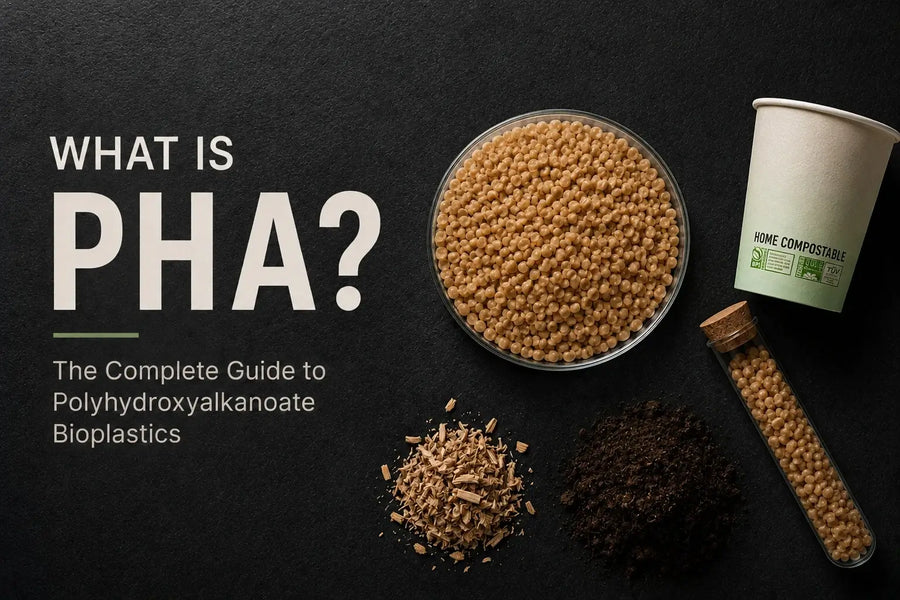
PlantSwitch is a material science company. We make CompostZero™, a PHA material made through fermentation from renewable feedstocks, develop the application and manufacture the finished products, so documentation comes from one source rather than a chain of hand-offs. Our cutlery, straws, stirrers and cutlery kits are certified home compostable and FDA-compliant for food contact, with certifications from bodies including TÜV Austria (OK compost HOME), BPI and DIN CERTCO.
We would rather give a buyer one claim they can prove than five they can't. Every PlantSwitch claim starts with a certificate.
We also say plainly what is still in progress. PHA as a material biodegrades in soil, freshwater and marine environments, but certification of CompostZero™ for soil and marine biodegradation is in progress, not granted, so we don't claim it. In California, compostable labeling for all compostable plastics, PHA included, depends on how the AB 1201 requirement is resolved. That is the kind of detail a strategy built on evidence needs to carry. Our research library collects the underlying studies.
Ask for samples and certificates
If you are rebuilding your packaging claims, start with the paperwork. Request samples and the certificates for the items you are considering, browse the product range, or email sales@plantswitch.com. You can read more about our approach on the sustainability page.
Make the switch